

With AxSpA, There’s No Such Thing as the “Perfect” Balance

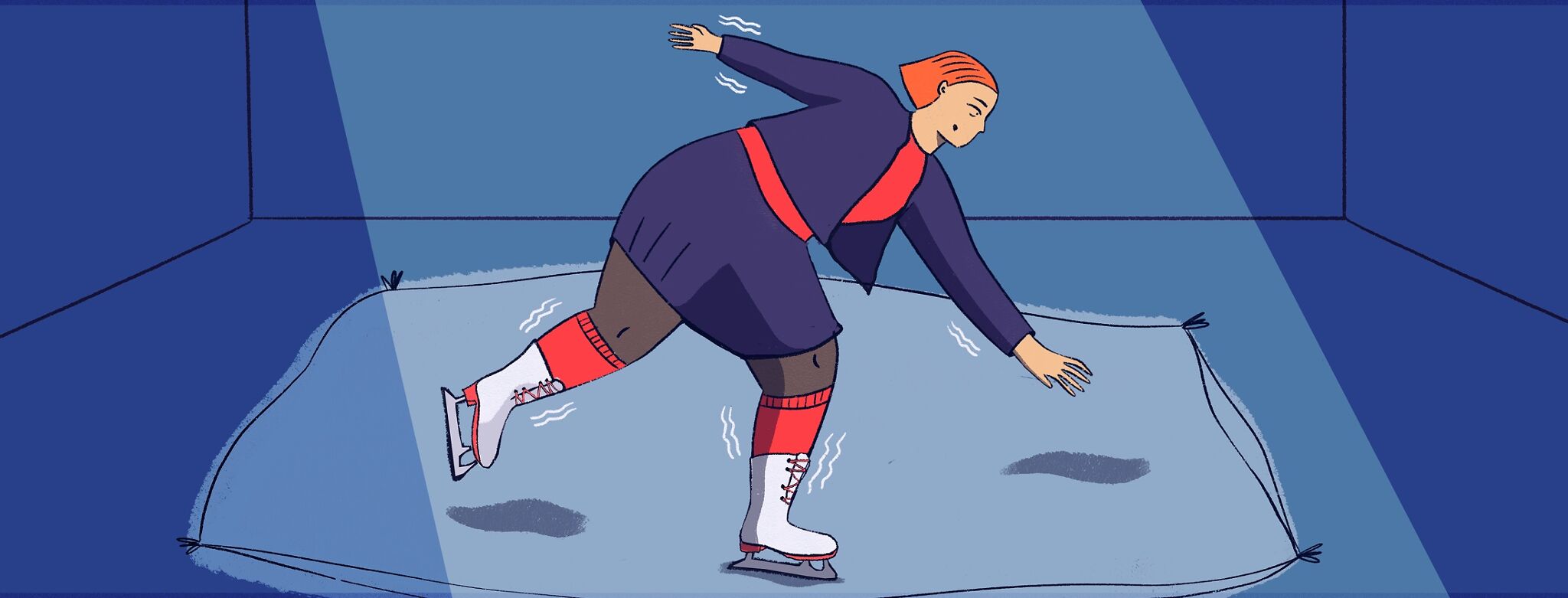
I started figure skating at 7 years old and learned to balance on a 4-millimeter-thick blade.
That taught me how easily one's balance can be thrown off – a slight turn of the head, an uncontrolled movement of the arm, or even a shift in pressure from toe to toe can send you crashing towards the hard ice below.
When I reflect on my life with axial spondyloarthritis, the same principle applies.
One wrong move, and everything could fall apart
My health is precarious and delicate. One wrong move could lead to a surge of pain or fatigue, so I must try to keep every aspect of my life in check.
All the while, just like in figure skating, the goal is to make it look easy – to not let others know how much effort it’s taking you to stay upright. Even without a chronic illness, life is enough of a balancing act.

Then you add chronic pain and fatigue to the mix, and it often feels like I’m falling behind in a race that I never even signed up for.
The endless time and energy it takes to just exist...
It’s astonishing how much time and energy it takes just to exist as a chronically ill person:
- Going to appointments
- Refilling and picking up prescriptions
- Managing pain
- Advocating for yourself
And more...
Then, there are the constant mental calculations we must do:
If I go to the office today, will I have enough energy to cook dinner tonight?
Will drinking some wine tonight be worth the inevitable flare-up tomorrow?
Every day is a series of tiny decisions that could have major consequences. How do I push my body far enough that I can live a full life, without pushing it too far?
Is there ever a perfect balance of it all?
Fortunately, after years on the ice, I’ve discovered the secret to perfect balance: it doesn’t exist.
That’s right – I’ve watched Olympic medal-winning skaters fall on their faces. No amount of preparation can prevent an unexpected rut in the ice, or an unwelcome flare-up.
Recognizing this has been incredibly freeing. Instead of expecting myself to balance everything perfectly all the time, I am learning to:
- Let myself stumble
- Cancel plans if needed
- Be mediocre sometimes (and be okay with it)
My "best" looks different than someone else's
When I’m struggling to accept the inevitable loss of balance, I find it helpful to remind myself that I am carrying the weight of my chronic illness with me wherever I go, so I shouldn’t compare myself to others who may not be.
Although we all have the same number of hours in a day, we don’t have the same resources to work with during those hours. Your “best” probably won’t look the same as someone else’s; in fact, your “best” today may not even look like your “best” tomorrow.
Priorities come with trade-offs, and I've learned to accept that
Since I’m stubborn by nature, I refuse to give up on living a full life just because I am chronically ill. As a result, my life is a swirling rotation of priorities taking the number-one spot.
That means that some days I go out with friends and my heart feels full, but my body feels depleted.
Other days, I choose to put extra energy into my work, then have nothing left to give my loved ones. The trade-offs ebb and flow.
There is no way to balance it all at the same time, so I keep spinning, becoming comfortable living in a state of flux.
My lessons learned after a decade of living with AxSpA
It’s been 10 years now that I’ve lived with AxSpA and I have yet to experience complete balance. I’ve come to realize that the most important thing that figure skating taught me wasn’t how to balance at all, but rather how to lose it, to fall down, and then unflinchingly get back up.
Join the conversation